Cracking the Men’s Song

G.W. (George Washington) Walker, a member of the Society of Friends (Quakers), visited Tasmania with a colleague, James Backhouse, for benevolent purposes. In 1832 they were at the Aboriginal establishment of Wybalena on Flinders Island, and both recorded their visit. Walker made a note of the following song:

“A favourite song chiefly of the men said to be learned from the Sydney blacks, but known by most of the Aborigines of V. D.’s land.
Pōppẙlă rēnŏngōnnẙnă pōppẙlă &c., poppyla, &c.
lēmĭngānẙă lēmĭngānẙă lēmĭngānẙă &c.
Tāūkŭmmĭngānẙă tāūkŭmmĭngānẙă, &c
Nȳnă tēpē rēna pōnnẙnă nyna tēpē rēnă, &c.
Nȳnă nāră pēwĭllẙ pāră nāră pēwĭllẙ
pāllăwŏŏ pāllăwŏŏ — Nyna nara &c.”
No translation was provided.
This first thing to note is that this was not learnt from any individuals from Sydney. The words are from Tasmania.
A version of this song appeared in Hobart, in The Courier, on 7 March 1846, in an article by R.H. Davies:
Ne popila raina pogana, Ne popila raina pogana, Ne popila raina pogana.
Thu me gunnea, Thu me gunnea, Thu me gunnea.
Naina thaipa raina pogana, Naina thaipa raina pogana, Naina thaipa raina pogana.
Naara paara powella paara, Naara paara powella paara, Naara paara powella paara.
Ballahoo, Ballahoo, Hoo, hoo!
Another version of it was recorded by Joseph Milligan, in turn recorded by N.J.B. Plomley:
Pāppĕlă Rāynā ‘ngōnẙnă, Pāppĕlă Rāynă ‘ngōnẙnă.
Pappela Rayna ‘ngonyna!
Tōkă mēnghă lēăh, Tōkă mēnghă lēăh,
Toka mengha leah!
Lūghă mēnghă lēăh, Lūghă mēnghă lēăh,
Lugha mengha leah!
Nēnă tāypă Rāynă poōnẙnă, Nēnă tāypa Rāynă poōnẙnă.
Nena taypa Rayna poonyna!
Nēnă nāwră pēwẙllăh, Pāllăh nāwră pēwẙllăh.
Pēllăwăh, Pēllăwăh!
Nena nawra pewyllah, pallah nawra pewyllah,
Pellawah, Pellawah!
Similarities between them become more evident when they are respelt in a consistent manner and set side by side:
| Walker: | Davies: | Milligan: |
1 | bubila rinangunina bubila | ni bubila rana bugana ni bubila rana bugana ni bubila rana bugana | babila rana ngunina, babila rana ngunana, babila rana ngunana |
2 | li minganya li minganya | Du mi ganiya Du mi ganiya Du mi ganiya |
|
3 | duga minganya duga minganya | Duga mi ganiya Duga mi ganiya Duga mi ganiya | duga minGa liya, duga minGa liya, duga minGa liya |
|
|
| luga minGa liya, luga minGa liya, |
4 | nana dibirina bunina nana dibirina | nana Daba rana bugana nana Daba rana bugana nana Daba rana bugana | nina daba rana bunina, nina daba rana bunina, nina daba rana bunana |
5 | nana nara biwili bara nara biwili | nAra bAra bawila bAra nAra bAra bawila bAra nAra bAra bawila bAra | nina nara biwila |
|
|
| bala nara biwila |
6 | balawu balawu | balawu balawu | bilawa bilawa |
| nana nara nana nara | wu wu |
|
No translations were provided by Davies or Milligan.
To begin an attempt at a possible meaning it would be useful to establish what such songs might be about. A clue is given on the same page as Walker’s untranslated song. Presented there is the following women’s song, including a translation, key words of which have been picked out in red boxes:

Points to be noted are:
the song is about animals;
the translation is given in the lines below the Australian language lines;
while the placing of the translations suggests that the English words are translations (or glosses) of the words directly above them, some consideration suggests that this is not the case; that is, while the overall sentence translation does appear roughly to match the words in the sentence, the glosses are not precisely placed under the words to which they relate;
a longish word might have actually been two words, and two small separated words might have been a single word;
there are some possible links to words in the untranslated song.
From these observations, a first leap at guessing a translation might be ventured: the untranslated song is about animals, fauna.
Your Amateur Researcher (YAR) then proceeded to attempt a word-by-word analysis, making use of the Tasmanian Bayala database. The following tables are not the database itself but are collections of summary lines drawn from the database.
Line 1: bubila rinangunina bubila
bubila
Australian | respelt | English | EngJSM | source |
"[Pabela [MS tabela]]" | babila | "[25 And God made the Beast of the Earth ...]" | big | Plom: Wilk [A597cal:42:41.13] [BLmd] [Tas] [1910] |
babila | "" | big [?] | Plomley gar [:48:41] [NE] [Tas] [c.1835] | |
"[Pãppĕlă]" | babila | "" | big | Plomley JMill [:46:13.11] [OyB] [Tas] [1857] |
"pawpela" | babila | "large" | big | Plomley mj [A610.mj:281:25] [OyB] [Tas] [1857] |
bubali-bariga | "stink" | stink [whiff] [big kangaroo [?]] | Plomley gar [:397:20] [dk] [Tas] [c.1835] | |
"[popila]" | bubila | "[The following is a song of the Ben Lomond tribe; I cannot translate it, nor, could I do so, is the subject very select]" | big [?] | Plom [Davies] [Courier:44:32.2] [BLmd] [Tas] [c.1846] |
Table 1 bubila: big
In this table the original spelling of the word varies considerably, but on respelling is revealed to be the same word. It might be respelt bubila or babila, but when these are spoken aloud they can be readily perceived to sound very much alike, and can be accepted as the same basic word.
Only the fourth entry clearly indicates the meaning ‘big’ (“large”).

rina
"ragana" | ragana | "Doe (forest)" | kangaroo female | Roth: vocabs [:10:38] [OyB] [Tas] [182730] |
"Ragana" | ragana | "forest doe" | kangaroo female | Braim, T.H. History of NSW from Settlement [:257.1:28] [OyB] [Tas] [c.1835] |
"ragana" | ragana | "forest doe" | kangaroo female | Jorgenson in Braim [A614:67.1:18] [OyB] [Tas] [c.1835] |
"ragana" | ragana | "forest doe" | kangaroo female | Plomley bm [A614jjBr:298:17] [OyB] [Tas] [c.1835] |
"[Rãynă]" | rana | "" | kangaroo | Plomley JMill [:46:13.12] [SE] [Tas] [1857] |
"[raina]" | rana | "[The following is a song of the Ben Lomond tribe; I cannot translate it, nor, could I do so, is the subject very select]" | kangaroo | Plom [Davies] [Courier:44:32.3] [BLmd] [Tas] [c.1846] |
"[raina]" | rana | "" | kangaroo | Plom [Davies] [Courier:45:7.3] [BLmd] [Tas] [c.1846] |
"rarryna" | rarina | "kangaroo, brush, joie" | kangaroo [joey] | Plomley mj [A610.mj:301:27] [SE] [Tas] [1857] |
"[ree-enna]" | riyina | "brush kangaroo" | kangaroo brush | Plomley mj [:298:21.2] [OyB] [Tas] [1857] |
"rena" | rina | "Kangaroo Boomer" | kangaroo | Roth: vocabs [:13:34] [SE] [Tas] [1826] |
"rena" | rina | "kangaroo, boomer" | kangaroo | Plomley sc [A597sct:298:18] [SE] [Tas] [1826] |
"Rena" | rina | "Kangaroo, Boomer" | kangaroo boomer | Scott, Thomas: Oyster Bay [:1.1:11] [OyB] [Tas] [1821] |
"{rena}" | rina | "kangaroo" | kangaroo | Bedford / WWM [:13:7.1] [OyB] [Tas] [1824] |
"[rēnŏ]" | rina | "xxx" | kangaroo | Walker, G.W. [B709:183:11.211] [BLmd] [Tas] [1832] |
Table 2 rina: kangaroo
There are many words in Tasmania for kangaroo. This could be because there were six or more languages, and possibly because different classes of kangaroo were being named, whether for sex, age, size, style (wallaby, boomer, euro etc.) One of these words was rina.
The table presents a variant ragana, and two spelling alternatives rarina and riyina, which might have been intended to represent rana and rina respectively, both very likely recordings of the same word rina.
ngunina
"[Nĕhnānĕh]" | nanana | "[The boomer, or buck of the forest The little]" | emu | Walker, G.W. [B709:183:3.4] [BLmd] [Tas] [1832] |
"Ngunanna" | ngunana | "Emu" | emu | Roberts, R.A. Vocab [:825.1:27] [SE] [Tas] [1828] |
"[ngõnẙnă]" | ngunina | "" | emu | Plomley JMill [:46:13.13] [SE] [Tas] [1857] |
"'ngunannah" | ngunana | "emu" | emu | Plomley mj [A610.mj:147:27] [SE] [Tas] [1857] |
"ngananna" | nganana | "Emu" | emu | Roth: vocabs [A 605:11:15.2] [SE] [Tas] [] |
"Ngunannah" | ngunana | "Emu" | emu | Barry, R. Vocab of Dialects: Tas Mt Royal, Brune Is [:3.94:55] [SE] [Tas] [1869] |
"[ngōnnẙnă]" | ngunina | "xxx" | emu | Walker, G.W. [B709:183:11.222] [BLmd] [Tas] [1832] |
"[nennana]" | ninana | "[the little emu]" | emu | Backhouse, James [:117:8.11] [OyB] [] [] |
"[nĕnnānĕh]" | ninana | "[... the little emu]" | emu | Plomley gww [B709:54:7.4] [dk] [Tas] [c.1838] |
Table 3 ngunina: emu
The various respellings of ngunina, when spoken aloud, suggest they are all the one word, meaning ‘emu’. The example in the first row is an illustration where the gloss below a word can be taken as not indicating the correct meaning for the word immediately above it.
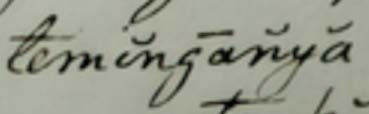
Line 2: li minganya
The crossing through the first letter, l, making it look like t, is actually a macron or overline over the next letter, e, intended to be ē.
li
"Lee" | li | "Kangr" | kangaroo | ML GAR: list B [B:51:6] [SE] [Tas] [1829-34] |
"Leigh" | li | "Kangaroo" | kangaroo | Jorgenson in Braim [A614:72.2:7] [dk] [Tas] [c.1835] |
"[lē]" | li | "xxx" | kangaroo | Walker, G.W. [B709:183:12.11] [BLmd] [Tas] [1832] |
"illăr" | lila | "Kangaroo" | kangaroo | Roth: Norman, Rev. James Port Sorrell [:3:33.3] [Nth] [Tas] [1832-67] |
"[lila]" | lila | "[25 And God made the Beast of the Earth ...]" | kangaroo | Plom: Wilk [A597cal:42:41.12] [BLmd] [Tas] [1910] |
"lila" | lila | "kangaroo" | kangaroo | Plomley lh [JRGeog:299:3] [OyB] [Tas] [1839] |
Table 4: li kangaroo
li is another of the numerous words for kangaroo. Included in the table are variants lila and possibly ila.
The original word lēmĭngānẙă is actually two words li and minganya.
minganya
"mengha" | minGa | "toe" | toe | Plomley mj [:97:42] [OyB] [Tas] [1857] |
"[mĭngānẙă]" | minganya | "xxx" | toe | Walker, G.W. [B709:183:13.2] [BLmd] [Tas] [1832] |
Table 5: minganya: toe
There are only two sources for this word representing ‘toe’, and only one with a gloss (toe).
minga has a variety of other meanings including blood, bring (get), fight, porpoise, pull, snail, throw and wrong, of which only ‘porpoise’ and ‘snail’ are possible alternative contenders for the meaning intended.

Line 3: duga minganya
tāūkŭmmĭngānẙă , or duga minganya, is another example of two words run together, the second of which is minganya, just seen in Table 5. That leaves only the first word, duga, to be considered.
duga
"[Thoga]" | Duga | "" | heel | Plom [Davies] [Courier:45:4.1] [BLmd] [Tas] [c.1846] |
"[Tõkă]" | duga | "" | heel | Plomley JMill [:46:15.11] [NE] [Tas] [1857] |
"[Tāūkŭ]" | duga | "xxx" | heel | Walker, G.W. [B709:183:13.1] [BLmd] [Tas] [1832] |
"To.ker" | duga | "Heel" | heel | ML GAR: A7085 [A7085:729:6] [NE] [Tas] [1829-34] |
"touger" | duga | "heel" | heel | Plomley gar [:97:17] [SE] [Tas] [c.1835] |
Table 6: duga heel
The first three records are from the three songs being examined here, for which there were no translations. The final two records are both from G.A. Robinson, clearly marked ‘heel’. It is this term, ‘heel’ that makes the meaning of ‘toe’ in Table 5 more likely than the other possibilities, heel and toe often being considered together in life.

Line 4: nana dibirina bunina
Walker specified that y is pronounced like i, but does not deal with ȳ and ẙ. It is assumed here that ȳ = ā, ẙ = ĭ.
nana
"[Nȳnă]" | nana | "xxx" | kangaroo rat | Walker, G.W. [B709:183:14.1] [BLmd] [Tas] [1832] |
"nine.ner" | nana | "[kangaroo rat]" | kangaroo rat | Plomley cr [:303:27] [BRiv] [Tas] [c.1838] |
"Nine.ner" | nana | "kangaroo rat" | kangaroo rat | ML GAR: A7085 [A7085:817:2] [BRiv] [Tas] [1829-34] |
Table 7: nana kangaroo rat
The Walker record in the first row is untranslated, but the other two, by Robinson, are marked ‘kangaroo rat’.
dibirina
This is the most puzzling of the words in the song. Is it one word or two words? YAR has taken it to be a single word.
"deeberana" | dibarana | "Girl" | girl | Roth: vocabs [A 605:12:23.1] [SE] [Tas] [1832] |
"Deeberana" | dibarana | "Girl" | girl | Roberts, R.A. Vocab [:825.2:10] [SE] [Tas] [1828] |
dibarani | "what" | whatsthat | ML GAR: list A [A:37:6] [NE] [Tas] [1830-32] | |
"neen.ner.tape.er.rane.ner" | nina dabarana | "to evacuate" | defecate | Plomley gar [:48:31] [NE] [Tas] [c.1835] |
Table 8: dibarana
None of the words in Table 8 seem appropriate for a song about animals.
So perhaps dibirina was two words after all: dibi/daba and rina/rana. A search for these words was then undertaken:
"tabba" | daba | "ham or hough" | ankle | Plomley mj [A610.mj:91:29] [SE] [Tas] [1857] |
"teb.ber" | diba | "to be married" | married | Plomley gar [:322:5] [SW] [Tas] [c.1835] |
"teba" | diba | "oyster" | oyster | Plomley drm [:271:39] [SE] [Tas] [1793] |
"Tepera" | dibara | "Come" | go-come | Curr 3 #A10a Jorgenson Eastern [3:621:8.1] [OyB] [Tas] [c.1835] |
"rarn.er" | rana | "[bone]" | bone | Plomley gar [:171:37] [SE] [Tas] [c.1835] |
"*Runna" | rana | "Waddy" | club | Jorgenson/Dove 5 Uncertain [:318:8] [BRiv] [Tas] [c.1835] |
"ran.ner" | rana | "finger Nail" | nail | ML GAR: A7085 [A7085:718:2] [SE] [Tas] [1829-34] |
"Rān.nĕr" | rana | "Shell" | shell | ML GAR: A7085 [A7085:764.1:22] [SE] [Tas] [1829-34] |
"Run.ner" | rana | "Kangr– skin" | skin kangaroo | ML GAR: list B [B:28:4] [NW] [Tas] [1829-34] |
"Ranana" | ranana | "Cold" | cold | Dove/D’Entrecasteaux [:47.2:24] [SE] [Tas] [c.1845] |
"Reena" | rina | "Finger" | finger | Roberts, R.A. Vocab [:825.2:1] [SE] [Tas] [1828] |
"Reén-nar" | rina | "Hand" | hand | ML GAR: A7085 [A7085:40:6] [NE] [Tas] [] |
"{rena}" | rina | "kangaroo" | kangaroo | Bedford / WWM [:13:7.1] [OyB] [Tas] [1824] |
"renah" | rina | "water rat" | rat water | Plomley mj [:308:24] [OyB] [Tas] [1857] |
"Rina" | rina | "Polish (to)" | rub | Lhotsky Tas Peron 1803 [JRGeog:162.1:37] [SE] [Tas] [1803] |
"Rina" | rina | "show" | show | Fier [?]: Esperance & Recherche Tas 1793 [d.2:1:32] [SE] [Tas] [1793] |
The only likely combination, given that ‘ankle’, ‘married’ and ‘go-come’ seem improbable, is the remaining daba/diba word oyster, and ‘shell’ out of the rina/rana group. There is only one diba example for ‘oyster’ in the collection of records in the database, but there are several for duba, including the following:
"toba" | duba | "oyster" | oyster | Fier [?]: Esperance & Recherche Tas 1793 [d.2:2:50] [SE] [Tas] [1793] |
Table 9: duba oyster
For the purpose of this tentative translation of the men’s song, ‘oyster shell’ has to be selected as the best fit. However, it is unlikely to be right if the song is about the sort of animals that run around in the forest.
So the database was then searched for words for fauna featuring the consonant sequence d/b/r/ found in dibirina, as well as d/r/b/ on the off-chance of imperfect transcription of the sounds in the original recordings, just to see what might emerge. The final /n/ was not included, -na being a very common suffix still of indeterminate significance. The following resulted:
"tarrabah" | daraba | "devil (D. ursinus)" | TasDevil [thylacine [?]] | Plomley mj [:293:37] [SE] [Tas] [1857] |
"tarripnyenna" | daribnyina | "opossum (ringtail)" | possum-having [?] [ringtail] | Plomley mj [A610.mj:306:18] [OyB] [Tas] [1857] |
dralibuna | "alias a platipus" | platypus | ML GAR: A7085 [A7085:796:5] [dk] [Tas] [1829-34] | |
"trip.per.lar" | dribala | "[Whale]" | whale | Plomley st [:312:32] [OyB] [Tas] [1828] |
"Trib.ber.rer" | dribara | "Seal" | seal | ML GAR: list A [A:5:6.2] [NE] [Tas] [1830-32] |
drubanagi | "Mawpork [mopoke]" | owl | ML GAR: list B [B:117:15] [SE] [Tas] [1829-34] | |
"trũbrãrnăr" | drubrana | "magpie" | magpie | Plomley sn [:151:27] [dk] [Tas] [1828?] |
Table 10: d/b/r/ and d/r/b/ words that are terms for fauna’
When the test of ‘animals that run around in the forest’ is applied, all of the words in Table 10 fail apart from the first two, and of these, daraba TasDevil, is simpler than daribnyina opossum. It is tempting to opt for TasDevil as the meaning for dibirina, but in the end it is only fair to admit that the interpretation of this word is unresolved.
bunina
"Par.neen.ner" | banina | "Snake" | snake | ML GAR: list B [B:37:6] [OyB] [Tas] [1829-34] |
"Pănéena" | banina | "snake" | snake | Westlake, Ernest Notebooks [4:8:7] [NE] [Tas] [c.1910] |
"pan.nen.ner" | banina | "petrel" | birdtype [petrel] | Plomley gar [:149:2] [OyB] [Tas] [c.1835] |
"pue.nen.ner" | bunina | "very small bird" | birdtype | Plomley gar [:160:16] [SE] [Tas] [c.1835] |
"pahneena" | banina | "husband" | man thee-of | Plomley mj [A610.mj:316:17] [SE] [Tas] [1857] |
"per.ne.ner" | banina | "your wife" | woman thee-of | Plomley cr [:473:34] [BLmd] [Tas] [c.1838] |
"Pare.ne.ner" | banina | "Muscle" | muscle [mussel/oyster?] | ML GAR: A7085 [A7085:728.1:27] [NE] [Tas] [1829-34] |
baninari | "to Grease" | grease | ML GAR: list B [B:49.2:2] [SE] [Tas] [1829-34] |
Table 11: bunina
bunina is another uncertain word, with likely interpretations of it being either ‘snake’ or ‘birdtype’. ‘Birdtype’ might possibly cover ‘emu’, especially as there are words similar to bunina in the database specifically identifying ‘emu’:
banana | "emu" | emu | Plomley cr [:147:33] [BLmd] [Tas] [c.1838] | |
banana | "Emu" | emu | ML GAR: A7085 [A7085:847:6] [BLmd] [Tas] [1829-34] |
Table 12: banana emu
A final avenue to pursue is through the word bugana, used in Line 4 by Davies instead of bunina.
There are numerous possibilities for this bugana alternative:
"puck.ar.ner" | bagana | "on eucalypts, flat, like native bread" | fungus | Plomley gar [:345:19] [OyB] [Tas] [c.1835] |
"pugganna" | bagana | "man (black)" | man | Plomley mj [A610.mj:317:11] [OyB] [Tas] [1857] |
"Poе.Капе.еr" | bugana | "Dead" | dead | ML GAR: list B [B:23:2] [NW] [Tas] [1829-34] |
"puck.kan.ner" | bagana | "call" | shout [sound] | Plomley gar [:179:30] [NE] [Tas] [c.1835] |
"pha.ca.nah" | bagana | "rain" | rain | Plomley bd [A76:369:4] [OyB] [Tas] [1914] |
"Par.can.ner" | bagana | "Sea" | sea | ML GAR: list B [B:11:10] [Nth] [Tas] [1829-34] |
"Bue.ger.ner" | bugana | "Dº [to Swim]" | swim | ML GAR: list B [B:87:3] [OyB] [Tas] [1829-34] |
"Puggana" | bagana | "Fish" | fish | Barry, R. Vocab of Dialects: Tas Mt Royal, Brune Is [:3.94:29] [SE] [Tas] [1869] |
"pookanah" | bugana | "albatross" | albatross | Plomley mj [:143:42] [OyB] [Tas] [1857] |
bugana | "what do you call this / that thing" | whatsthat [?] | Bedford / WWM [:13:2] [OyB] [Tas] [1824] |
Table 13: bugana: Various possibilities
There seems only one genuine possibility for use in a song about animals, and that is ‘albatross’, even though this is not an animal that runs around in the forest. Table 13 presents it as one of five words connected with water. If, in southerly parts of Tasmania, bugana should really have a meaning such as ‘water-related’, then rain, sea, swim, fish and albatross, might have been mistaken for the meaning of the word when the enquiring European’s Aboriginal interlocutor used the word bugana. Likewise if, in more northerly parts of the island, bugana should have meant ‘man’, then man, dead and shout might have been mistaken by this European for the meaning of bugana when it was said to him or her.

Line 5: nana nara biwili bara
nana
See table Table 7: nana kangaroo rat
nara
"Nar.rar" | nara | "Cock er too" | cockatoo | ML GAR: list B [B:46:9] [SE] [Tas] [1829-34] |
"Nyrae" | nara | "Good" | good | TAS Mulligan [sic] Vocab Ref CY821 [A 605:1.1:6] [SE] [Tas] [1875] |
"Nare.rer" | nara | "Meeni mene [?] or Grass" | grass | ML GAR: list B [B:50.1:3] [NW] [Tas] [1829-34] |
"Nare.rer" | nara | "Bush" | scrub | ML GAR: list B [B:18:3] [NW] [Tas] [1829-34] |
"{Nara}" | nara | "{they, he, her, then, or that}" | he | Braim, T.H. History of NSW from Settlement [:259.3:4.12] [Nth] [Tas] [c.1835] |
"Nar.rer" | nara | "Him" | him | ML GAR: A7085 [A7085:832:5] [BRiv] [Tas] [1829-34] |
"{nara}" | nara | "they, he, her, then or that" | that [him [?]] | Plomley jj [A614jjBr:363:25.3] [SW] [Tas] [c.1835] |
"Nara" | nara | "they" | they-all | Jorg in Braim 141-6 [:144:1.4] [SE] [Tas] [c.1846] |
"narra" | nara | "you, thou" | thou | Backhouse, James [:118:19] [OyB] [] [] |
Table 14: nara ‘he/they’, ‘that’ or something else
Nara is a commonly occurring word wth several meanings. Perhaps ‘that’ is the most likely as used in the men’s song.
The possibilities for meanings when no translation is provided seem almost limitless. When YAR checked for words for ‘albatross’ featured in table 13, the words that emerged were damima, damina, damuna, darim, darima, darimi, darina and namanaran, all much of a muchness apart from the last, which was recorded at Cape Grim in the far north west:
"num.mer.ner.rown" | namanaran | "albatross C G" | albatross | ML GAR: A7085 [A7085:783.1:1] [NW] [Tas] [1829-34] |
Table 15: namanaran albatross

It might be a fluke that namanaran resembles quite closely the first two words in Line 5, nana nara, and it might be another fluke that the meaning for it, ‘albatross’, is the same meaning as that for the word given by Davies in the preceding line, bugana, featured in Table 13.
biwili
biwili is another word of uncertain meaning.
"pãrwărlăr" | bawala | "yes" | yes | Plomley sn [:478:28] [Nth] [Tas] [1828?] |
"Pooalih" | buwali | "Two" | two | Curr 3 #A12b Milligan South [3:666:9.2] [SE] [Tas] [1859] |
"pue.wil.le" | buwili | "(sick)" | ill | Plomley gar [:48:35.1] [NE] [Tas] [c.1835] |
"boilé" | buwili | "new (not old)" | new | Plomley mj [A610.mj:327:12] [SE] [Tas] [1857] |
"pãrvẽe" | bawi | "little" | little | Plomley st [:396:41] [SE] [Tas] [1828] |
"Pārvēe" | bawi | "Little" | little | ML GAR: A7085 [A7085:763.1:10] [SE] [Tas] [1829-34] |
"Pay.ween.ner" | bawina | "Low Water" | little | ML GAR: list B [B:66:13] [OyB] [Tas] [1829-34] |
"[pēwĭllẙ]" | biwili | "xxx" | little | Walker, G.W. [B709:183:15.2] [BLmd] [Tas] [1832] |
Table 16: biwili little [?]
The database did not turn up any close matches to biwili. The first four rows in Table 16 are somewhat similar to biwili but the meanings for them, yes, two, ill and new, are not promising possibilities. ‘little’ has been suggested for this word based on the bawi examples following, but the meaning for biwili must at best be classified as uncertain.
bara
bara forms part of a large number of words or wide-ranging meanings. The principal returns for bara by itself are the following:
"par.rar" | bara | "muttonfish" | fishtype [muttonfish] | Plomley gar [:271:12] [OyB] [Tas] [c.1835] |
"Pār.rār" | bara | "Mutton fish" | fishtype muttonfish | ML GAR: A7085 [A7085:763.1:21] [SE] [Tas] [1829-34] |
"Par.rer" | bara | "Boomer Kangaroo" | kangaroo | ML GAR: list B [B:96:1] [SE] [Tas] [1829-34] |
"pare.rer" | bara | "native parsnip" | tuber [parsnip] | Plomley gar [:352:42] [OyB] [Tas] [c.1835] |
Table 17: bara fish, kangaroo, tuber ?
Parsnip seems unlikely for a song about animals, and kangaroos were dealt with earlier. This leaves only the possibility of a fish. But if the first word in Line 5 were albatross, what do albatrosses search for if not fish?
Line 6: balawu
It might be noted that in Line 6 as rendered by Davies and Milligan an exclamation mark is used. This suggests the word is used as an exclamation.
"Pār.lĕr.văr" | balawa | "Native" | man | ML GAR: A7085 [A7085:763.1:18] [SE] [Tas] [1829-34] |
"par.ler.var" | balawa | "yes" | yes | Plomley gar [:478:31] [SE] [Tas] [c.1835] |
"[pallawaa]" | balawA | "[black snake]" | snake | Plomley mj [A610.mj:455:14.1] [NW] [Tas] [1857] |
"Par.neen.ner" | banina | "Snake" | snake | ML GAR: list B [B:37:6] [OyB] [Tas] [1829-34] |
"Powranna" | barana | "Snake" | snake | Jorgenson 4 Northern [:317:12] [NW] [Tas] [c.1835] |
"Pow.wer.rer" | bawara | "Snake" | snake | ML GAR: list B [B:65:5] [NW] [Tas] [1829-34] |
"Warl.i.pare" | waliba | "War cry" | warcry | ML GAR: A7085 [A7085:906.2:15.2] [BRiv] [Tas] [1829-34] |
"Par.le.vah" | baliwa | "what" | huh | ML GAR: list B [B:133:15] [SE] [Tas] [1829-34] |
"pallawaleh" | balawali | "what?" | huh | Plomley mj [A610.mj:465:35] [SE] [Tas] [1857] |
"[Ballahoo]" | balawu | "" | warcry | Plom [Davies] [Courier:45:13.1] [BLmd] [Tas] [c.1846] |
"[Pẽllăwăh]" | bilawa | "" | warcry | Plomley JMill [:46:22.1] [SE] [Tas] [1857] |
"pāllăwŏŏ pāllăwŏŏ — Nyna nara &c." | balawu | "xxx" | warcry | Walker, G.W. [B709:183:16.12] [BLmd] [Tas] [1832] |
Table 18: balawu Exclamation
The first two rows in Table 18 feature words unlikely to be exclamations.
The first of the middle group of words, balawA (the capital A indicates a long sound of /a/: compare the first sound in the English words barter and butter as pronounced in Australia to hear the difference between long and short /a/) means ‘snake’. Other somewhat similar words for snake are given for comparison. A call of ‘snake!’ could be an exclamation, and might be appropriate in a song about animals.
Only one word in the database is translated as ‘war cry’: Warl.i.pare, respelt as waliba, shown as the first word in the third group in Table 18.
Metathesis is term used in linguistics to indicate the reversal of sounds of syllables, without change of meaning. When metathesis is applied to waliba the result could be similar to the remaining entries in Table 18, this word being effectively phonically reversed, so that wa-li-ba becomes ba-li-wa. There is only the one translation offered, ‘what?’, indicated as the exclamation ‘huh’. The other entries are all taken from the men’s song and so are untranslated. They are indicated as ‘warcry’, but they could also be equally validly represent an exclamation: ‘snake!’.
Conclusion
In summary, a translation of the men’s song, based on the observations above, might be:
bubila rinangunina bubila | big kangaroo emu |
li minganya | kangaroo toe |
duga minganya | heel toe |
nana dibirina bunina | kangaroo-rat TasDevil albatross |
nana nara biwili bara | albatross little fish |
balawu balawu | snake! snake! |

Jeremy Steele
12 July 2026


Comments